
Calhoun County Court Records After a Jail Arrest
After an arrest in Calhoun County, the case moves from the sheriff to two court offices. The Calhoun County Clerk of Court and Comptroller, Robin Barfield, holds the case files, dockets, and dispositions. The Office of the State Attorney for the 14th Judicial Circuit, led by Larry Basford, decides what charges to file and prosecutes the case for the State of Florida. The jail roster shows the arrest and booking charges, but the court record is what the prosecutor files and the court tracks from there.
Two kinds of records sit side by side, and they answer different questions. The booking and custody side, including the roster and booking photos, is covered on the jail inmate records page and the jail roster mugshots page. The court record itself is the filed charges, the charge status, bond orders, and the final outcome. Reading both together is the only way to see the full picture after an arrest.
How to Find Calhoun County Court Records After an Arrest
Calhoun County court cases are searched through the Online Court Records Search, or OCRS, run by Civitek and linked from the Clerk's website. Public access is anonymous after you accept a disclaimer, while attorney, registered-user, and party access need an account. The clerk's criminal court page explains which court handles which case.
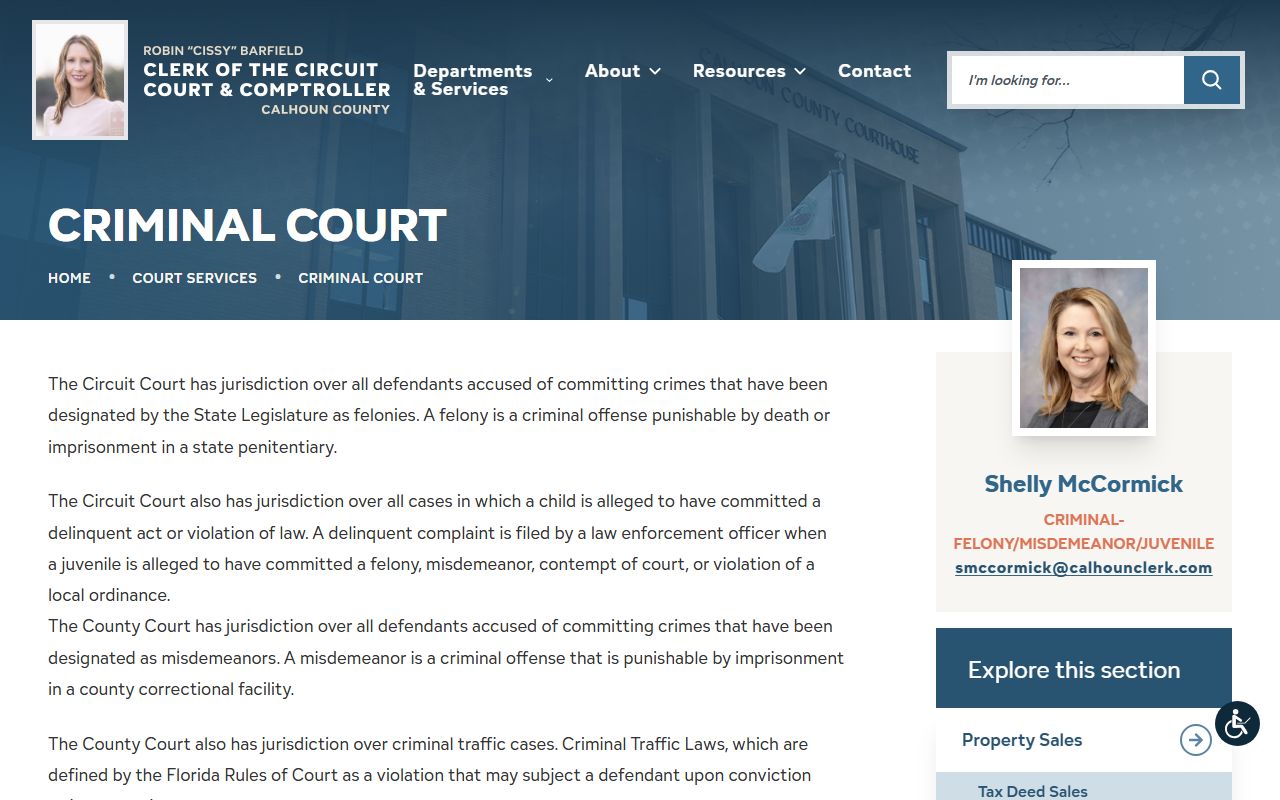
The clerk's criminal court page lays out felony, misdemeanor, and criminal-traffic jurisdiction, which is why the OCRS court-type filters matter after an arrest.
Read the Calhoun County Clerk criminal court page to see how Circuit Court felony cases and County Court misdemeanor and criminal-traffic cases are split before you search.
With the case type in mind, open the OCRS portal and search the public index using the steps below.
- Open the Calhoun County OCRS portal and choose the Public access option.
- Accept the disclaimer, then search by defendant name or, if known, case number.
- Open the case and read the charge list and the charging document.
- Check each charge's code, level, and current status, and use the Felony, Misdemeanor, and Criminal Traffic filters to narrow results.
For criminal history that reaches beyond Calhoun County cases, the Florida Department of Law Enforcement runs a statewide search under section 943.053. A public criminal-history search there was listed at $24, with added processing fees and a turnaround of several business days for certified copies.
How Charges Get Filed After an Arrest: Complaint, Information, and Indictment
The court record begins when a charging document is filed. Booking at the jail does not set the formal charges; the prosecutor does that after reviewing the arrest. In Florida most felonies are charged by information filed by the State Attorney, the most serious cases can go through a grand jury indictment, and lower-level matters often start from a complaint. The table sorts the three out.
| Complaint | Information | Indictment | |
|---|---|---|---|
| Filed By | Officer / prosecutor | State Attorney | Grand jury |
| Common For | Misdemeanors | Many felonies | Serious felonies |
| Starts | The case | The case | The case |
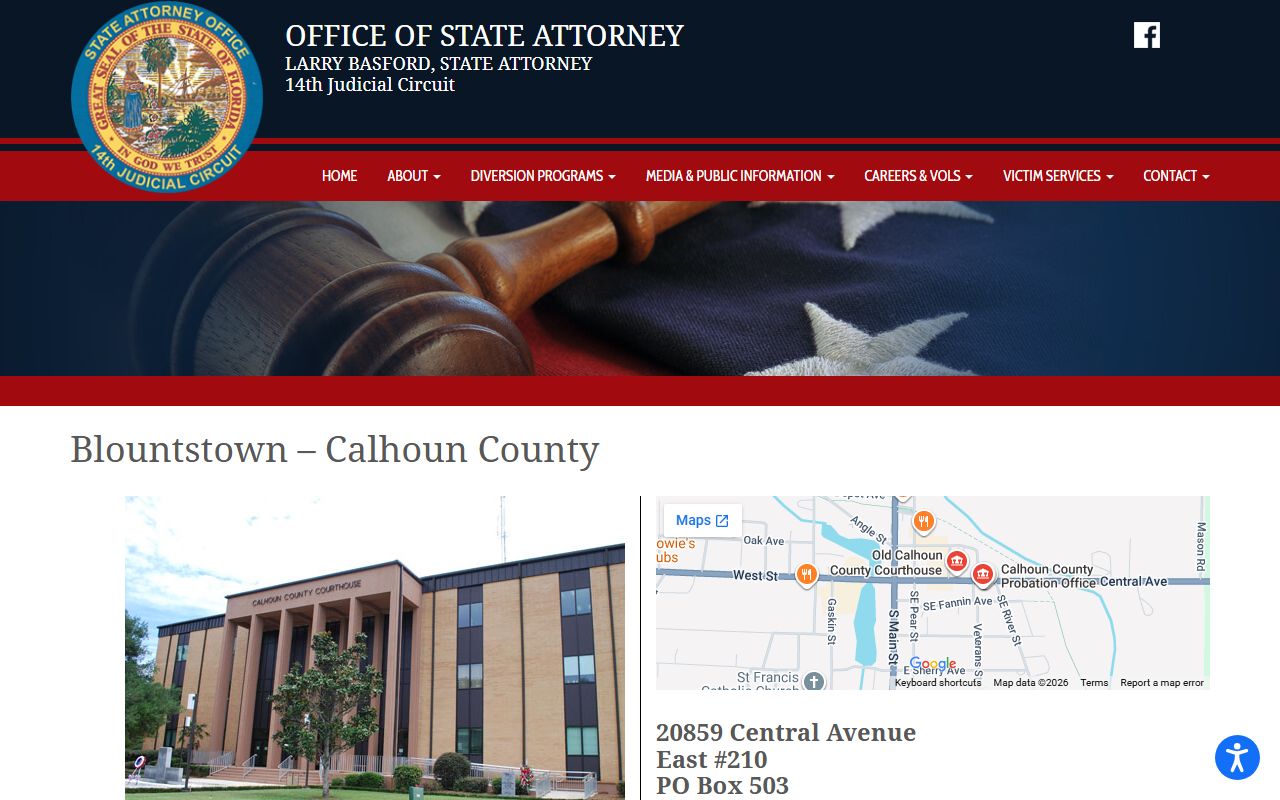
The State Attorney's office covers Bay, Calhoun, Gulf, Holmes, Jackson, and Washington counties, and it advises the grand jury in each one. Its local Calhoun office sits in the same Central Avenue East courthouse cluster as the Clerk.
The State Attorney Calhoun County office page lists the Blountstown office that files and prosecutes charges after a local arrest.
Because the prosecutor reviews each arrest, the charge that opens the court case may not match the charge written at booking.
Charge Status and What It Means After an Arrest
Charges change as a case moves. The prosecutor can file, amend, reduce, add, dismiss, or decline charges, so the booking charge on the roster is only a starting point. The court docket carries the current status, and a few terms come up again and again. The table defines the common ones.
| Status | What It Means |
|---|---|
| Pending | The case or charge is open and not yet resolved. |
| Amended / Reduced | The charge was changed or lowered to a lesser offense after filing. |
| Dismissed | The court or prosecutor ended the charge without a conviction. |
| Nolle Prosequi | The prosecutor formally declined to go forward with the charge. |
Note: A jail roster lists arrest charges, not the court's final word, so always confirm the outcome of a charge in the court docket rather than the booking record.
Bond and Release After an Arrest
Bond is usually addressed at first appearance, an early hearing after an arrest. A Florida court weighs the factors in section 903.046 when setting bail, including the offense, the weight of the evidence, ties to the community, employment, financial resources, prior record, and any danger to the community. The Calhoun roster shows bond by charge, and a comment can control release, such as a cash-only note or a hold for another agency. The table covers the common bond types.
| Bond Type | How It Works |
|---|---|
| Cash Bond | The full amount is paid in cash to secure release; a charge can be marked cash-only. |
| Surety Bond | A licensed bail agent posts the bond for a fee, when the charge and court allow it. |
| PR / Own Recognizance | Release on a written promise to appear, usually by court order. |
| No-Bond Hold | No release on that charge or hold; common with detainers and some violations. |
Even when local bond is posted, a hold from immigration, another county, probation, or the court can keep a person in custody. Confirm with the jail before posting bond.
Warrants That Lead to an Arrest
Many bookings start with a warrant. The Calhoun County Sheriff's Office runs a Civil Process and Warrant office on the first floor of the Historic Calhoun County Courthouse, open weekdays from 8 a.m. to 4 p.m. Central time, reachable at 850-674-5049. No public online active-warrant list was found, so a blank search is not proof that no warrant exists. To check for a warrant, contact the warrant office, search OCRS for bench-warrant or failure-to-appear entries in a case, or use the sheriff's public records channels. Once a warrant is served and the person is booked, the roster can show the charge, a warrant number, and any bond or hold.
State Attorney Records and Victim Notification
The court file is held by the Clerk, but the prosecutor's office keeps its own records, and those follow Chapter 119 too. The State Attorney for the 14th Judicial Circuit lists a public-records process with set copy costs, such as 15 cents for a one-sided copy and 20 cents for a double-sided copy, plus hourly service charges for time beyond the first 30 minutes. A broad request that needs legal review can run up against the office's senior-attorney review rate, so a narrow, specific request is usually cheaper and faster.
Prosecutor files are also more likely than a simple booking record to carry exemptions or victim protections. Victim information can be redacted, and the Sheriff's Office and the State Attorney both run victim-services contacts. For custody and release alerts tied to a case, VINELink provides statewide notifications rather than leaving you to recheck a docket by hand.
Charges vs. Convictions
An arrest and a charge are accusations, not proof of guilt. A conviction comes only from a plea or a verdict. Both an arrest record and a conviction are public in Florida, but they sit at very different stages of a case, and treating a charge as a conviction is a serious error.
| Charge | Conviction | |
|---|---|---|
| Stage | Accusation | Verdict or plea |
| Burden of Proof | Probable cause | Beyond a reasonable doubt |
| Public Record | Yes | Yes |
Sealed vs. Expunged Arrest Records
After a dismissal or an eligible outcome, a person may be able to clear an arrest record. Florida draws a line between sealing a record and expunging it, and the State Attorney's office runs a seal-and-expunge process under the state expunction statutes. The table compares the two.
| Sealed | Expunged | |
|---|---|---|
| Visibility | Hidden from public view | Destroyed or treated as if it never existed |
| Law Enforcement | Limited access remains | Very limited access |
| Eligibility | Set by Florida statute; one prior seal or expunge usually disqualifies | Often after a dismissal or no charges filed, under Florida law |
Florida's court-ordered expunction statute, section 943.0585, sets the process. Clearing a record can also remove a booking photo from the official roster, a route explained on the jail roster mugshots page.
Background Check Considerations
A casual public-records lookup is not the same as a regulated background check. Formal screening for jobs, housing, credit, or insurance must follow the federal Fair Credit Reporting Act and use a licensed consumer reporting agency. Court records you read for personal knowledge do not carry those protections or that accuracy review.
Important: This site is not a consumer reporting agency under the FCRA, and nothing here may be used to decide employment, housing, credit, or insurance.
Restricted Court Records After an Arrest in Calhoun County
Not every record after an arrest is open. Florida exempts juvenile matters, sealed or expunged cases, certain victim information, and active investigative material under the public-records exemptions in section 119.071, and court records carry their own access rules under section 119.0714. Online court access is also governed by a statewide administrative order, not only by general public-records practice. Attorney, party, and registered-user logins can expose documents that the public view does not, so a thin public result does not always mean a thin file.